

A few years ago, marketing teams planned campaigns quarterly. Today, visibility shifts weekly.
Search trends change overnight. Competitors launch new campaigns constantly. Social media conversations move in real time. Audience behavior changes faster across platforms. Content velocity has increased massively. AI-generated discovery is changing how users search and consume information.
At the same time, leadership expectations have also evolved.
Businesses no longer evaluate marketing only on impressions, reach, or engagement. They expect faster execution, sharper decisions, clearer visibility, stronger optimization, and measurable business impact.
This is creating a new operational challenge for modern marketing teams.
How do businesses maintain clarity and responsiveness inside environments that continuously change?
This is exactly where AI copilots are beginning to reshape modern marketing operations.
Not as standalone automation tools. But as operational intelligence layers helping businesses navigate growing marketing complexity with greater speed and confidence.
The Operational Problem Most Marketing Teams Experience
-BsdFEM3r.jpeg)
Consider a common situation.
A business is simultaneously managing SEO, social media, content production, campaigns, GMB visibility, website optimization, analytics, and reporting workflows.
Every week generates new operational signals: rankings fluctuate, engagement patterns change, campaigns shift performance, competitors launch activity, audience behavior evolves, and optimization priorities move constantly.
Now multiply this across multiple teams, multiple brands, multiple regions, or multiple stakeholders.
Very quickly, marketing stops becoming only an execution challenge. It becomes an operational visibility challenge. Because teams are no longer struggling to produce activity.
They are struggling to continuously identify:
- what matters most,
- what needs attention,
- what is changing,
- and what decisions should happen next.
This is where AI copilots become operationally valuable.
What Is an AI Copilot in Marketing?
-CwrW0Zjy.jpeg)
An AI copilot is not simply a chatbot inside a platform.
In modern marketing operations, an AI copilot functions as a connected intelligence layer that helps teams process operational signals faster, surface relevant insights, identify optimization opportunities, organize priorities, and support faster decision-making.
Think of it less as 'automation.' And more as operational assistance at scale.
For example: Instead of manually reviewing ranking reports, website analytics, campaign dashboards, engagement trends, competitor movement, and workflow updates separately, an AI-assisted operational layer can help surface visibility shifts, performance anomalies, trend movement, optimization priorities, and operational risks within one connected environment.
The result is not replacing marketing teams. The result is reducing operational friction.
Why Traditional Marketing Operations Struggle to Scale

One of the biggest hidden problems inside growing marketing environments is operational overload.
As businesses scale, teams usually add more channels, more campaigns, more reporting, more dashboards, more meetings, and more workflows.
But adding more operational layers does not always improve decision quality. In many organizations, it creates the opposite: slower coordination, delayed optimization, fragmented visibility, and inconsistent prioritization.
A Gartner report highlighted that marketers today manage more data sources and platforms than ever before, yet many teams still struggle to convert visibility into faster decisions.
Because modern marketing complexity is no longer just an execution issue. It is an intelligence management issue. This is why AI copilots are increasingly becoming part of future-ready marketing frameworks.
A Situation Marketing Teams Commonly Relate To
Imagine an ecommerce business preparing for a festive campaign season.
The business is actively running Meta campaigns, Google Ads, SEO landing pages, influencer collaborations, email workflows, YouTube creatives, and local search optimization.
During the campaign:
- some products trend unexpectedly,
- competitor pricing changes rapidly,
- engagement shifts toward short-form content,
- branded searches increase,
- certain landing pages outperform,
- while some campaigns begin weakening.
Now the marketing team needs to answer critical questions quickly:
- Which products deserve more promotion?
- Which campaigns need optimization?
- Which channels are creating the highest purchase intent?
- Which audience segments are shifting behavior?
- Where should budget allocation change?
Without connected operational intelligence, teams spend enormous time manually interpreting fragmented visibility. By the time decisions happen, momentum may already shift again.
AI copilots help reduce this lag.
By continuously analyzing connected operational movement, businesses gain faster visibility into where attention should move next.
How AI Copilots Improve Marketing Operations
1. Faster Visibility Into Operational Changes
One of the biggest advantages of AI-assisted operational systems is speed.
Instead of waiting for reporting cycles, teams gain earlier visibility into traffic anomalies, engagement shifts, keyword movement, campaign fatigue, visibility drops, or competitor momentum. This allows businesses to optimize proactively instead of reactively.
2. Smarter Prioritization Across Teams
Modern marketing teams constantly compete for operational attention.
SEO needs optimization. Content needs production. Campaigns need monitoring. Websites need updates. Leadership needs reporting.
AI copilots help organize operational priorities based on performance movement, visibility trends, business goals, and emerging signals. This helps teams focus energy where business impact is likely to be highest.
3. Reduced Manual Analysis
A large percentage of marketing effort today still goes into reviewing dashboards, exporting reports, compiling updates, identifying anomalies, and coordinating visibility.
AI-assisted systems reduce this operational burden by helping surface what changed, why it matters, and where attention should move. This creates more time for strategic thinking and execution.
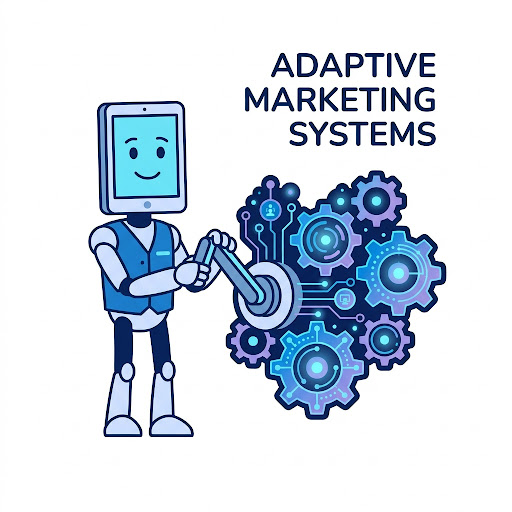
4. More Adaptive Marketing Systems
Traditional marketing frameworks often depend on fixed planning cycles. But modern environments evolve continuously. AI copilots support adaptive marketing operations by helping businesses respond faster to trend movement, competitor shifts, audience behavior, search intent changes, and performance fluctuations.
This creates significantly more responsive marketing environments.
AI Copilots Are Not Replacing Marketing Teams
One of the biggest misconceptions around AI in marketing is that it replaces human decision-making. In reality, high-performing marketing organizations are increasingly using AI copilots to strengthen human decision quality.
Because marketing still requires creativity, strategic thinking, brand understanding, audience empathy, and business context.
AI copilots simply help teams process operational complexity faster.
The businesses benefiting most from AI today are often the ones using it to improve visibility, reduce operational friction, accelerate optimization, and support sharper decision-making.
Conclusion
Modern marketing environments are becoming too dynamic for fragmented operational systems.
Businesses today need frameworks capable of continuously connecting intelligence, visibility, execution, optimization, and decision-making within one adaptive operational environment.
This is why AI copilots are becoming increasingly important in future-ready marketing operations.
Not because they automate everything. But because they help businesses navigate complexity with greater clarity, responsiveness, and operational confidence.
Platforms like Marketing 4Sight are part of this shift toward connected, intelligence-driven marketing systems where AI-assisted operational support, visibility, and data-driven decision making continuously strengthen marketing performance across evolving business environments.